



Read about our accomplishments in the 2023 Oregon Legislative Session.

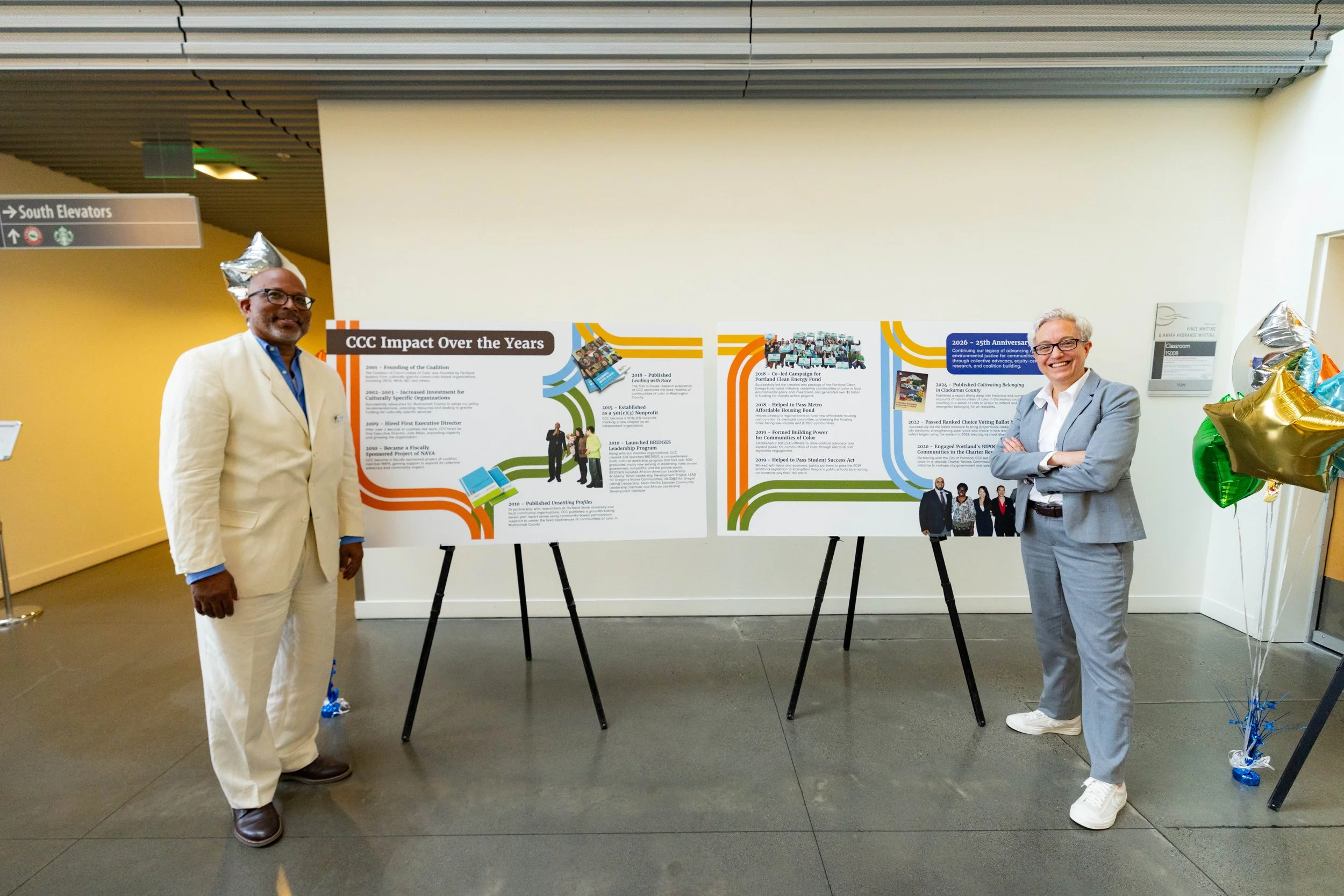
From celebrating our 25th year at our Summer Soirée to strengthening community power through opportunities and milestones from our research, environmental justice, and advocacy teams at CCC, catch up on the latest by reading our summer newsletter!
The 2026 Legislative session has officially wrapped. Despite it being a short session with only 35 legislative days to pass policies, CCC members were hard at work and successful in passing meaningful policies to protect immigrants and refugees, improve tenant rights and access to housing, expand access to childcare for working families and more! Read our full recap.
This Black History Month, we honor a founder who has made a lasting impact in Portland—through the organization he started for Black youth and families and as a driving force behind establishing the Coalition of Communities of Color 25 years ago.
Tony Hopson Sr. sat down with us to reflect on his upbringing, the shifts that transformed culturally specific services, and why working across racial lines matters more than ever.
Read our first newsletter of the year! From action opportunities to protect climate justice investments in Portland to advocating for legislative policies in Salem to protect our communities, we hear many opportunities to continue legacies of freedom and change built by Black Americans this Black History Month. Plus we share the latest findings from our Nonprofit Study in partnership with the Nonprofit Association of Oregon.
The Coalition of Communities of Color advocates for ballot measures to help fulfill our mission to address the disparities, racism, and inequity of services experienced by communities of color, and to seek social change so we can obtain self-determination, justice and prosperity. We advocate for ballot measures that will move us toward this goal.
This November’s ballot measures gives voters the chance to bring more voices into our democracy, create a more accountable government, invest in parks and nature, and advance health care and racial justice.
The Coalition of Communities of Color urges you to vote YES on the following ballot measures:
YES on Measure 26-228 - City of Portland Charter Reform
YES on Measure 26-231 - Extending Voting Rights - Multnomah County
YES on Measure 26-232 - Ranked Choice Voting - Multnomah County
YES on Measure 26-225 - Metro Parks and Nature Levy
YES on Measure 111, Measure 112, and Measure 113
Learn more about each of these measures on our full 2022 Voters’ Guide, and you can download a printable version of CCC’s voter guide here.
The Oregon State Legislature adjourned Saturday, June 26. Over the course of the session, we moved from some of the most acute COVID-related public health impacts toward an equitable recovery marked by meaningful action for racial justice.
2020 made the conversation on racial justice more salient than ever at the legislature, and CCC was positioned to help pass groundbreaking racial equity legislation. Read the original priority agenda we set in January, and learn more about how CCC develops its legislative agenda here.
Amidst the challenges of an all-remote session, CCC had a more robust legislative advocacy program than ever under the leadership of our new Advocacy Director, Elona J. Wilson. We regularly testified at hearings and informational briefings, submitted written testimony, met with legislators, supported coalition and grassroots organizing, and spoke with the media to advance our racial justice agenda. Beyond our direct lobbying, we also were invited to speak at informational briefings including the structural racism of our tax system, improving community access to the legislature, and making legislative service more accessible for all Oregonians who want to hold office.
Our member organizations and partners came together and built powerful coalitions to achieve these wins. The BIPOC Caucus—representing the largest class of Black, Indigenous, and people of color (BIPOC) legislators ever—demonstrated the power of collective action and led the way toward racial justice. Three of these legislators have strong ties to CCC. Sen. Kayse Jama, former executive director of our member Unite Oregon, Rep. Khanh Pham, former Manager of Immigrant Organizing at our member APANO, and Rep. Andrea Valderrama, CCC’s former Advocacy Director, all played critical leadership roles. We thank all of the members of the caucus for their leadership, and to their allies who joined them in this effort.
In addition to CCC’s agenda, our members saw significant wins on items like $80 million in safety investments on 82nd Avenue, Cover All People (health care for all eligible low-income Oregonians, regardless of immigration status), increasing access to mental health care for BIPOC Oregonians, and many more. We celebrate their leadership and the victories they won to strengthen their communities.
The Oregon Clean Energy Opportunity campaign’s three bills all passed with broad support, positioning us toward a more equitable climate future. This statewide campaign brought together an unprecedented coalition of frontline advocates from rural, coastal, BIPOC, and low income communities who worked tirelessly to take action for climate justice.
Energy Affordability (HB 2475) will help Oregon families afford their energy bills through lower energy rates for residential ratepayers with lower incomes who most need the relief.
100% Clean Energy for All (HB 2021) will transition Oregon’s electricity to 100% clean energy by 2040—the fastest timeline in the nation. It centers benefits for the communities and workers most impacted by climate change and extractive industries.
Healthy Homes (HB 2842) invests $20 million in fixes to make homes safer to live in and more affordable to heat and cool while providing living wage jobs through home repairs work.
Our environmental justice team played a critical role in this coalition. Nikita Daryanani, CCC’s Climate & Energy Policy Manager, said, “Oregonians in every part of the state are going to see major benefits from more clean energy, such as good-quality jobs, community ownership of disaster-resilient solar projects, and less air pollution,” with the entire package helping low-income families afford their utilities and essential home repairs.
Welcoming Refugees and Office of Immigrant and Refugee Advancement
Immigrant Oregonians are part of our families, communities, workplace, classmates and faith communities. We all deserve the opportunity to thrive, which includes providing the support our immigrant and refugee communities need, and ensuring they are safe from unfair harassment and profiling.
Sen. Kayse Jama, the first former refugee elected to the Oregon State Senate and former executive director of CCC member organization Unite, led the passage of legislation to create a state Office of Immigrant and Refugee Advancement (SB 778), and allocated resources as part of Welcoming Refugees (SB 718 and ultimately passed in the budget bill) so that our state can better support our community members who make Oregon their home.
Sanctuary Promise Act
Immigrant Oregonians deserve safety, fairness, and dignity. Voters and legislators have expressed their commitment to these values, but in practice, we are failing to meet them. Just like other Oregonians, they should be free from racial profiling and threats to their safety The Sanctuary Promise Act (HB 3265) strengthens and clarifies Oregon law to live up to these values of safety and fairness for immigrant communities. It draws a clear line between our local institutions and federal immigration enforcement and allows those unjustly harmed to enforce their rights in court.
Oregon IDA Initiative
Matched savings accounts (Individual Development Accounts, known as IDAs), are a critical asset-building tool for BIPOC Oregonians to help them achieve their financial goals such as entrepreneurship, higher education, or buying a home. A number of CCC’s members participate in this program. This year, the initiative emerged even stronger, with the passage of the coalition’s entire legislative package, including full funding and changes that will benefit participants by making it easier to save and better meet their needs.
Child Care for Oregon
Our child care system has long failed to meet the needs of working families. Like other inequities, this burden falls heaviest on BIPOC families in Oregon. With the COVID pandemic devastating the system, the need for sustained public investment has never been clearer. A strong, racially equitable child care system is essential to the wellbeing of our children and economic opportunity of our families. HB 3073 is a step toward building a child care system that works for all Oregonians. The passage of this bill will allow for better coordination of services and funding; help rebuild the child care sector after the pandemic; and provide immediate relief to our most vulnerable families trying to access child care during the recession by reforming the Employment Related Day Care program to better serve children, parents, and providers.
CCC was an active member in a new coalition, Oregon Partners for Education Justice. Together, we worked to build a legislative agenda to invest in a more inclusive, equitable and racially just public education system through policy and investments in the success of students of color. This year, we also worked to pass HB 2001, a critical strategy to maintain a racially, ethnically, and linguistically diverse educator workforce that supports student success, especially for BIPOC students.
With Oregon’s eviction moratorium set to expire on June 30, we worked as part of the Stable Homes coalition to pass SB 282, which would give tenants until February 2022 to repay their back rent and provided other protections. While not ideal for tenants, the infusion of federal rent assistance and hard work of service providers would help Oregonians stay in their homes. When it became clear that rent assistance would not be disbursed in time, the Legislature passed SB 278 to ensure renters who were waiting on assistance would not be evicted. Given the challenges with getting rent assistance to those in urgent need, we are seriously concerned that stronger action is needed to ensure no one loses their home due to the pandemic.
Ranked choice voting (SB 791), a voting method that allows every voter’s voice to count, and improved voter demographic data collection (HB 2745) did not pass this session. We look forward to returning next session. While our priority bills did not pass, other major improvements for our electoral system passed, including language access for the voter pamphlet and counting ballots postmarked by election day, did make it through.
After the murder of George Floyd and the uprisings for Black lives, CCC took up community safety and transforming the legal system as a top priority with renewed urgency. This legislative session, HB 2002 was our top priority in that effort. The bill would have limited unnecessary police stops and arrests, transformed community supervision with approaches that promote public safety and success, and invested $8 million to community-based, culturally specific services.
Despite the legislature’s stated commitment to racial equity, and the recognition of the profound harm that the criminal legal system does to Black and brown Oregonians, a small number of legislators blocked this legislation in the final stages. Our coalition accepted many amendments that pared down the bill, but we know the final version would have been a meaningful step toward justice that would benefit the Oregonians who have been—and those we know will be—devastated by our criminal legal system.
While this was a painful missed opportunity for major change, we are heartened that some important policies in HB 2002 ultimately passed in other bills. Through SB 620, Oregon became the second state in the nation to eliminate fees for post-prison supervision, probation, and parole, helping tens of thousands of folks impacted by the criminal legal system achieve financial stability so they can care for their families. HB 2172 also expanded earned leave for Oregonians on post-prison supervision, allowing a greater reduction in time on supervision so folks can focus on rebuilding their lives and connecting with their community after incarceration.
A number of important investments also came out of this advocacy, including new grant-supported Restorative Justice programs (HB 2204); the Reimagine Safety Fund, Black community-led workgroup that will develop community safety alternatives, and funding for the Criminal Justice Commission to support a Transforming Justice Initiative that invests in communities of color with practices that equitably reshape Oregon’s public safety system.
CCC also worked to secure resources for our members to provide community-based, culturally-specific responses to gun violence through American Rescue Plan funds, but we know that this is ultimately just filling a gap. We also credit the BIPOC Caucus leading the way toward police reforms. But real change is needed more urgently than ever.
As a member of the Transforming Justice Coalition that fought to pass HB 2002, our Advocacy Director Elona J. Wilson said, “‘We’re deeply disappointed that Senate leadership didn’t step up, but we’re not going to stop fighting for the policies our communities need.” We call upon the legislature to pass these reforms in the short session next year, we will put in our full effort, and we will accept nothing less.
The road toward systemic change is long, but we reached a number of new milestones this year. All of the bills passed will improve the lives of BIPOC Oregonians and make our state stronger. These were only possible thanks to the years of organizing by community advocates. Their work laid the groundwork for real change amidst the ongoing crisis of the pandemic. As we celebrate our wins, we know we have much work to do to continue building our coalitions for racial justice. This session was historic in many ways, but like every session, we leave with much more to do. Over the coming months, we will develop our priorities that will build on our wins and continue to fight for the change our communities need, preparing for the 2022 legislative session, the elections, and beyond. We know that the power of community is transformative, and we will continue to build this power through the collective action of our members and many partners who share our vision for racial justice in Oregon. We hope you will join us in this journey.
Our legislative advocacy work is only possible through the support of our donors. Systemic change relies on individual supporters who believe in our mission for racial justice. Please consider celebrating our victories and preparing for the work ahead by making a contribution today. Thank you.
The 2021 legislative session has just begun, and the Coalition of Communities of Color is proud to release our priority legislative agenda. Every session, CCC engages throughout the legislative process to pass bills that increase opportunity and advance racial justice for communities of color.
As we continue respond to the pandemic, we also are looking to systemic change that will create a more equitable future for all. Our agenda is made up of legislation identified by our members, who work directly with communities to build solutions that will enable Black, Indigenous, and other Oregonians of color to thrive.
Supporting Families
Community Safety
Economic Justice
Strengthening Democracy
Immigrant and Refugee Justice
Environmental Justice
We'll also be building on our work around education justice, health equity, and more. Learn more about specific legislative items on our website here, and you can also download a PDF of our agenda. We'll be adding updates and more information as the legislative session advances, as well as opportunities for community members to get involved.
Learn more about CCC’s endorsement process and what it means here. The positions on our agenda represent only the position of CCC as a coalition and not individual members. Please contact CCC's Advocacy Director, Elona Wilson, at elona@coalitioncommunitiescolor.org with questions.
May 29, 2020
TO: An Open Letter to Community — Portland, Oregon, United States of America
FROM: Marcus C. Mundy, Executive Director, Coalition of Communities of Color
RE: We Can’t Breathe
Eric Garner could not breathe. George Floyd could not breathe. I cannot breathe.
I, my brothers, my son, my cousins, my friends – Black men all – watched in abject, stultifying horror this week as yet another Black man died at the hands of yet another policeman in yet another video broadcast to the world as if it were some rerun detached from reality. It was not detached from reality. It is reality. Our daily, inescapable reality as Black men in America.
We know all the victims’ names by now. We know the outcomes. We all know, step by inexorable step, the Kabuki theater that ensues after each such incident, the choreographed recitation of the injustice. The video is shared; the indignation is palpable; the protests begin; the lawyers go on television;usually, the perpetrators are not punished; the laws don’t change; police training doesn’t change; the cycle begins again…
Many tears were shed as we collectively and individually watched replays, on the daily news no less, of the very life oozing out of a man who looked just like us, right in front of our eyes. Such frequency of these events, I believe, attempts to numb us to its harshness, but: it cannot, not for Black men or those who love us. Our mere existence in the world as Black men should not evoke such rage from others, and such callous indifference for human life should evoke outrage, not just from Black people, but from all people.
I would trade a million virtue-signaling lawn signs stating “Black Lives Matter” and “In Our America, Love Wins” for a single day of those epigrams being realized. Arbery, Bland, and Cooper must not be the ABCs of Black life in America. They should be our societal wake-up call.
As the Mayor of Minneapolis reminded us, “If you had done it or I had done it we would be behind bars right now.” But it wasn’t the mayor, or me, or you; it was a craven Minneapolis “peace officer” who committed this incomprehensible act as his three equally culpable and enabling colleagues looked on. No charges filed, investigation underway. So here we go again.
Fannie Lou Hamer once plaintively said, over 50 years ago, “…I am sick and tired of being sick and tired.” She was speaking about civil rights then, but that phrase should apply to all of us right now, especially when it comes to the incessant, inhuman ways that Black men are treated in America. This person violated not just the civil rights Ms. Hamer was speaking of, but the most essential human right: the right to live.
After witnessing the replay of the slow motion demise of George Floyd, many of us feel horror; but that horror no longer means anything without action. Our bromides and platitudes and good intentions and righteous indignation, however heartfelt, are as a flatus in the wind unless we are prepared to work for change, and respectfully demand that change.
I reflected today that the mission of the Coalition of Communities of Color (CCC) is to “address the socioeconomic disparities, institutional racism and inequity of services experienced by our families, children and communities; and to organize our communities for collective action resulting in social change to obtain self-determination, wellness, justice and prosperity.” If little else is clear, institutional racism and inequity of services are real, and evidenced in the treatment of George Floyd. We must see what is happening in the world and, with our mission in mind, commit ourselves to action.
We must, and immediately:
work to remove any policies on our existing jurisdictions’ books similar to those in Minneapolis, which may permit the use of the procedure used to kill George Floyd;
work to facilitate and codify the implementation of suggestions developed by groups such as the Portland Police Reform Network, the Albina Ministerial Alliance Coalition for Justice and Police Reform, etc., in a formalized process;
work to strengthen the Independent Police Review Division and the Citizen Review Committee, with the goal of adding power to compel testimony;
seek to facilitate and codify change in Oregon State Statutes, as appropriate, for use of deadly force by officers;
work to have jurisdictions commit to training/retraining all law enforcement officers on proper use of force decision making matrices;
work to have jurisdictions commit to explicit, comprehensive Diversity, Equity, Inclusion training for all law enforcement officers, as well as heightened de-escalation training;
work to seek and acquire a commitment from all police unions, governmental leaders and officers in Oregon to condemn illegal or immoral behavior from police officers
The CCC urges all of you to take the steps we have outlined, with us. There is more than one pandemic raging in America, and none will be solved without collective action.
Join us. Help us end the reruns of “Another Black Man Killed Today Show”.
Join us. Help us breathe again.
“The ultimate tragedy is not the oppression and cruelty by the bad people but the silence over that by the good people.”
Does it dry up
like a raisin in the sun?
Or fester like a sore—
And then run?
Does it stink like rotten meat?
Or crust and sugar over—
like a syrupy sweet?
Maybe it just sags
like a heavy load.
Or does it explode?